
Dengue in a Changing Climate: Why Cases Continue to Rise

Updated: Aug 18
Written by Dr. Zack Ferris in TheSkyMeds Editorial Standards
Medically reviewed by Jonathan Reed, Medical Content Reviewer Jul 1 2026
Introduction
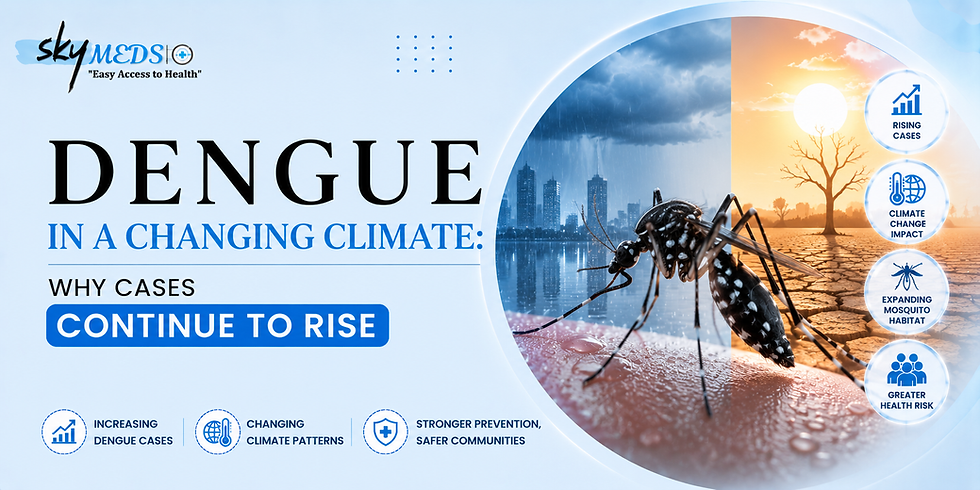
Many people think dengue outbreaks happen only during the rainy season. But over the past few decades, that assumption has become less accurate. Dengue is appearing in new locations, outbreaks are becoming larger, and transmission seasons are lasting longer.
According to global health experts, dengue infections have increased dramatically over recent decades, affecting hundreds of millions of people every year. Scientists increasingly recognize that changing climate conditions are playing a major role.
Warmer temperatures, irregular rainfall, expanding cities, and shifting ecosystems are creating ideal conditions for disease-carrying mosquitoes. As a result, understanding Dengue Prevention and environmental changes has become more important than ever.
Key Takeaways
Rising temperatures help mosquitoes survive and reproduce faster.
Unpredictable rainfall creates more breeding sites.
Urban growth contributes to mosquito population expansion.
Extreme weather events influence dengue outbreaks.
Global travel increases the spread of dengue viruses.
Prevention and community awareness remain essential.
Understanding Dengue Fever
Dengue is a viral infection transmitted primarily through the bite of infected Aedes aegypti mosquitoes.
Symptoms can range from mild fever and body aches to severe complications requiring hospitalization.
Common symptoms include:
High fever
Severe headache
Muscle and joint pain
Skin rash
Nausea and vomiting
Fatigue
Although most people recover, severe dengue can become life-threatening if not treated promptly.
Why Are Dengue Cases Increasing?
The rise in dengue cases is not caused by one factor alone. Instead, several environmental and human-related changes are working together.
Climate Change Creates Favorable Conditions
Mosquitoes thrive in warm and humid environments. As average temperatures rise, these insects can survive in areas that were once too cool for them.
Warmer weather also speeds up:
Mosquito breeding cycles
Virus development inside mosquitoes
Mosquito biting frequency
This means transmission can happen more rapidly.
Researchers studying Climate Change and infectious diseases have found that even small temperature increases can significantly affect mosquito populations.
Rising Temperatures Extend Mosquito Seasons
In many regions, mosquito activity used to decline during colder months. Today, warmer temperatures are extending breeding seasons.
This results in:
Longer periods of disease transmission.
Larger mosquito populations.
More opportunities for outbreaks.
Areas previously considered low risk are now reporting dengue cases.
Countries in South America, Southeast Asia, and parts of Europe have experienced changing transmission patterns as temperatures continue to rise.
Irregular Rainfall Creates Breeding Sites
Rainfall patterns are becoming less predictable.
Heavy rains can leave standing water in:
Buckets
Flower pots
Tires
Roof gutters
Water tanks
These small pools become ideal mosquito breeding grounds.
Interestingly, droughts can also increase dengue risk. During water shortages, people often store water in containers around their homes. Without proper covering, these containers become mosquito habitats.
Urbanization and Population Growth Contribute to Outbreaks
Rapid urban expansion has changed how dengue spreads.
Crowded cities provide:
Dense human populations
Poor waste management
Water storage containers
Construction sites with stagnant water
These environments support mosquito reproduction.
The Role of Mega Cities
Large cities often experience repeated outbreaks because mosquitoes and humans live in close proximity.
Poor sanitation and inadequate infrastructure increase vulnerability, especially in developing regions.
Understanding Mosquito Control strategies has become a key component of urban public health planning.
Extreme Weather Events Affect Disease Patterns
Climate change has increased the frequency of extreme weather events.
These include:
Flooding
Heatwaves
Hurricanes
Cyclones
Floods may create temporary breeding habitats, while heatwaves accelerate mosquito development.
After natural disasters, healthcare systems may become overwhelmed, making disease control more difficult.
Global Travel Helps Spread Dengue
Modern travel allows viruses to move across borders rapidly.
An infected traveler can unknowingly carry dengue to another region. If mosquitoes capable of transmitting the virus are present, local outbreaks may follow.
This interconnected world means dengue is increasingly becoming a global challenge rather than a regional one.
How Climate Change and Dengue Are Connected
A Growing Public Health Concern
Scientists studying Vector-Borne Diseases have identified several links between climate and dengue transmission.
Climate Factor | Impact on Dengue Transmission |
Rising temperatures | Faster mosquito reproduction |
Heavy rainfall | More breeding sites |
Drought conditions | Increased household water storage |
Flooding | Expanded mosquito habitats |
Humidity | Higher mosquito survival |
Urban heat islands | Longer transmission periods |
This relationship explains why outbreaks are becoming more frequent and widespread.
Areas Previously Unaffected Are Becoming Vulnerable
Historically, dengue was concentrated in tropical regions.
Today, changing environmental conditions have expanded mosquito habitats into:
Higher altitudes
Subtropical areas
Temperate regions
Communities with little prior exposure may have lower immunity, increasing the risk of outbreaks.
Healthcare systems in these regions may also be less prepared.
Challenges Facing Public Health Systems
Managing dengue outbreaks is becoming increasingly difficult.
Health authorities must deal with:
Growing case numbers
Limited resources
Increased hospitalization demands
Difficulty predicting outbreaks
Expanding mosquito habitats
Early warning systems and climate-based surveillance are becoming important tools.
Importance of Community Participation
Government programs alone cannot eliminate dengue.
Communities play a critical role by:
Removing stagnant water
Covering water containers
Maintaining clean surroundings
Using insect repellents
Installing window screens
Public awareness remains one of the most effective forms of prevention.
Advances in Dengue Prevention
Researchers and health organizations are developing new approaches to reduce transmission.
These include:
Improved Surveillance Systems
Modern data analysis helps predict outbreaks based on weather patterns.
Vaccines
New vaccines offer additional protection in certain populations and regions.
Biological Mosquito Control
Scientists are exploring environmentally friendly methods, including releasing mosquitoes infected with beneficial bacteria that reduce virus transmission.
Smart Public Health Strategies
Combining weather forecasting with disease monitoring may help authorities prepare for outbreaks before they occur.
Dengue is no longer only a tropical disease issue—it is increasingly becoming a climate issue, requiring cooperation between healthcare systems, communities, and environmental policies.
Practical Steps Individuals Can Take
Reducing dengue risk starts at home.
Eliminate Standing Water
Inspect your surroundings regularly and empty containers that collect rainwater.
Protect Yourself From Mosquito Bites
Use:
Mosquito repellents
Long-sleeved clothing
Window screens
Bed nets when necessary
Seek Early Medical Attention
Symptoms such as persistent fever, severe pain, or unusual bleeding require prompt evaluation.
Support Community Programs
Neighborhood cleanup campaigns and public awareness initiatives strengthen Public Health efforts and reduce mosquito breeding opportunities.
Conclusion
Dengue cases continue to rise because climate change, urbanization, population growth, and global travel are creating conditions that favor mosquito survival and disease transmission.
Warmer temperatures and changing rainfall patterns are expanding mosquito habitats and extending transmission seasons. As a result, dengue is affecting more communities than ever before.
While scientists and public health agencies continue developing new tools, prevention still begins with awareness and community action. Addressing dengue requires a combination of environmental management, healthcare preparedness, and collective responsibility.
The challenge is growing, but informed communities and proactive public health measures can help reduce the impact of this increasingly climate-sensitive disease.

FAQ Section
1. Why is dengue becoming more common?
Dengue is increasing due to warmer temperatures, changing rainfall patterns, urbanization, and increased international travel.
2. Does climate change affect mosquito populations?
Yes. Higher temperatures and humidity create ideal conditions for mosquitoes to survive and reproduce.
3. Can dengue occur outside tropical regions?
Yes. Mosquito habitats are expanding into subtropical and some temperate regions because of changing climate conditions.
4. How can I reduce mosquito breeding around my home?
Remove standing water, clean containers regularly, and cover water storage tanks.
5. Are vaccines available for dengue?
Yes. Some vaccines are available, but their use depends on age, previous infection history, and local health guidelines.
6. What is the most effective way to prevent dengue?
Preventing mosquito bites and eliminating breeding sites remain the most effective strategies.


Comments