
Brand vs Generic Medicine Prices: Why the Same Drug Can Cost Differently

Updated: Aug 21
Written by Dr. Adam Makis in TheSkyMeds Editorial Standards
Medically reviewed by Jonathan Reed, Medical Content Reviewer Jul 24 2026
Introduction
Imagine standing at the pharmacy counter and discovering that one version of your prescribed medicine costs five times more than another—even though both contain the same active ingredient. It's a common experience that leaves many people wondering if the cheaper option is somehow less effective.
The truth is that the price difference usually has less to do with the medicine itself and more to do with how it was developed, marketed, and sold. Understanding these differences can help you save money without compromising your treatment.
Key Takeaways
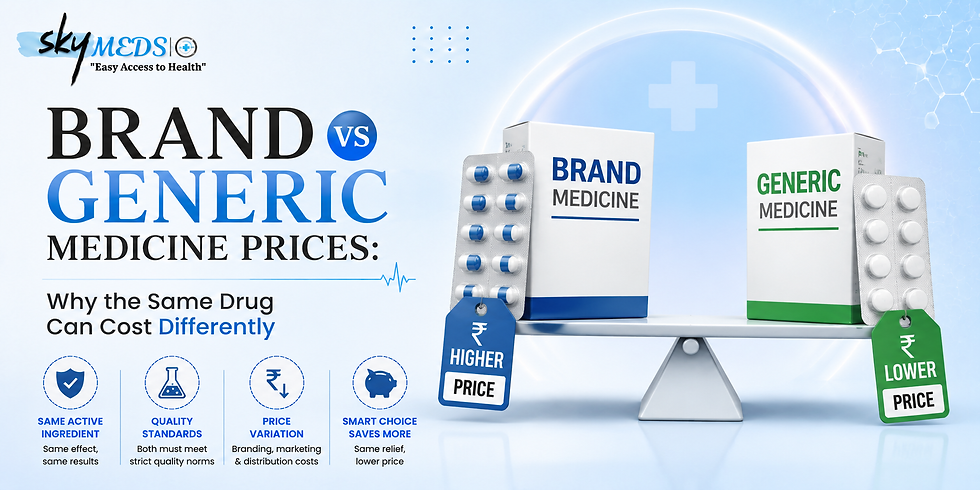
Brand-name medicines are usually more expensive because of research, development, marketing, and patent protection.
Generic medicines contain the same active ingredient, strength, dosage form, and intended use as their brand-name counterparts.
Regulatory authorities require generic medicines to meet strict quality, safety, and effectiveness standards.
Competition among manufacturers often lowers generic medicine prices.
Patients should always consult healthcare professionals before switching medications.
What Are Brand-Name Medicines?
Brand-name medicines are the original products developed by pharmaceutical companies after years of scientific research, laboratory testing, and clinical trials.
When a company discovers a new drug, it invests significant resources into:
Drug discovery
Laboratory research
Clinical trials
Regulatory approvals
Manufacturing facilities
Marketing campaigns
Post-market safety monitoring
Because these investments can take more than a decade and cost hundreds of millions—or even billions—of dollars, companies receive patent protection that gives them exclusive rights to sell the medicine for a limited period.
This exclusivity allows manufacturers to recover research and development expenses before competitors enter the market.
What Are Generic Medicines?
Generic medicines are versions of brand-name medicines introduced after patent protections expire or when other legal conditions allow competition.
These medicines contain:
The same active ingredient
The same dosage strength
The same dosage form
Comparable quality standards
The same intended medical use
Although the packaging, color, or shape may differ, approved generic medicines are expected to perform similarly when used as directed.
Brand vs Generic Medicine: A Quick Comparison
Feature | Brand Medicine | Generic Medicine |
Active Ingredient | Same | Same |
Safety Standards | Strict | Strict |
Effectiveness | Proven | Required to demonstrate comparable performance |
Research Costs | High | Lower |
Marketing Costs | High | Lower |
Patent Protection | Yes (for a limited time) | No |
Average Price | Usually Higher | Usually Lower |
Why Are Brand Medicines More Expensive?
Several factors contribute to higher prices.
1. Research and Development Costs
Developing a new medicine often requires years of scientific work before it reaches patients.
Companies invest in:
Drug discovery
Animal studies
Human clinical trials
Regulatory submissions
Manufacturing development
Many experimental drugs never reach the market, so successful medicines also help offset the costs of unsuccessful research.
2. Patent Protection
Patent laws give pharmaceutical companies temporary exclusive rights to manufacture and sell a medicine.
Without competition, manufacturers generally have greater flexibility in setting prices during the patent period.
3. Marketing and Promotion
Brand manufacturers spend substantial amounts on:
Advertising
Educational campaigns
Physician outreach
Conferences
Product branding
These expenses are reflected in the medicine's final price.
4. Continued Research
Many companies continue researching additional uses, improved formulations, or combination therapies even after a medicine reaches the market.
Why Are Generic Medicines Usually Cheaper?
Generic manufacturers avoid many of the expenses faced by the original developer.
They Don't Repeat Drug Discovery
The active ingredient has already been researched extensively.
Generic companies focus on producing approved versions rather than discovering an entirely new medicine.
Lower Marketing Costs
Generic manufacturers generally spend much less on advertising and promotional campaigns.
Instead, they compete primarily on price.
Competition Reduces Prices
Once multiple manufacturers begin producing the same medicine, increased competition often drives prices down.
This is one of the biggest reasons medicine prices can differ so significantly.
Are Generic Medicines Safe?
One of the biggest myths is that lower price means lower quality.
In reality, regulatory agencies require approved generic medicines to meet established standards for:
Manufacturing quality
Purity
Stability
Strength
Safety
Performance
Facilities are inspected, and manufacturers must comply with strict quality requirements.
Why Can Prices Still Differ Between Generic Medicines?
Even generic medicines may have different prices.
Reasons include:
Manufacturer Differences
Some companies produce medicines more efficiently than others.
Distribution Costs
Transportation, storage, and supply chain expenses vary between manufacturers.
Pharmacy Pricing
Different pharmacies may negotiate different purchasing prices, influencing the final amount paid by consumers.
Market Competition
A medicine with many manufacturers is often less expensive than one produced by only a few companies.
Does a Higher Price Mean Better Quality?
Not necessarily.
Price alone does not determine the quality or effectiveness of a medicine.
Healthcare professionals generally recommend choosing medications based on:
Medical advice
Regulatory approval
Availability
Personal health needs
Cost considerations
Rather than assuming a higher price equals better treatment, it's important to discuss options with your doctor or pharmacist.
When Might a Brand Medicine Be Preferred?
Although generic medicines are suitable for many patients, there are situations where a healthcare provider may recommend a brand-name product.
Examples include:
Certain medicines with a narrow therapeutic range
Specific formulations that are not yet available as generics
Patient-specific medical considerations
Clinical judgment based on individual needs
Patients should never switch between products without consulting their healthcare provider.
Tips to Save Money on Prescription Medicines
If you're looking to reduce healthcare expenses, consider these practical strategies.
Ask your doctor whether a generic option is available.
Compare prices between pharmacies.
Check whether your insurance plan has preferred medicines.
Ask pharmacists about lower-cost alternatives.
Review your medications regularly with your healthcare provider.
Purchase medicines only from licensed pharmacies.
These simple steps can help lower expenses while maintaining appropriate treatment.
The smartest healthcare decision isn't always choosing the most expensive medicine—it's choosing the medicine that's safe, effective, appropriate for your condition, and recommended by your healthcare professional.
Conclusion
Understanding why brand-name and generic medicines have different prices empowers patients to make better healthcare decisions. While brand medicines often reflect years of research, development, and marketing investments, generic medicines provide more affordable options once competition enters the market.
The key is remembering that cost is only one factor. Always discuss treatment options with your healthcare provider and purchase medicines from trusted, licensed pharmacies. By combining professional medical advice with informed financial decisions, you can often manage healthcare costs without sacrificing quality.
Frequently Asked Questions
1. Are generic medicines as effective as brand medicines?
Approved generic medicines are expected to perform similarly to their brand-name counterparts when used as directed.
2. Why are generic medicines cheaper?
They generally avoid the original research and development costs and compete with multiple manufacturers.
3. Can I switch from a brand medicine to a generic medicine?
Consult your doctor or pharmacist before making any changes to your prescribed medication.
4. Are generic medicines tested for safety?
Yes. They must meet regulatory standards for quality, safety, and manufacturing before approval.
5. Why do pharmacies charge different prices?
Pricing can vary because of purchasing agreements, operating costs, and competition.
6. Is the most expensive medicine always the best?
No. A higher price does not necessarily mean better quality or better treatment outcomes.


Comments