
Covilife MBD 275: Ingredients, Uses, and Safety

Written by Elizabeth Chernoby in TheSkyMeds Editorial Standards
Medically reviewed by Jonathan Reed, Medical Content Reviewer Sept 19 2026
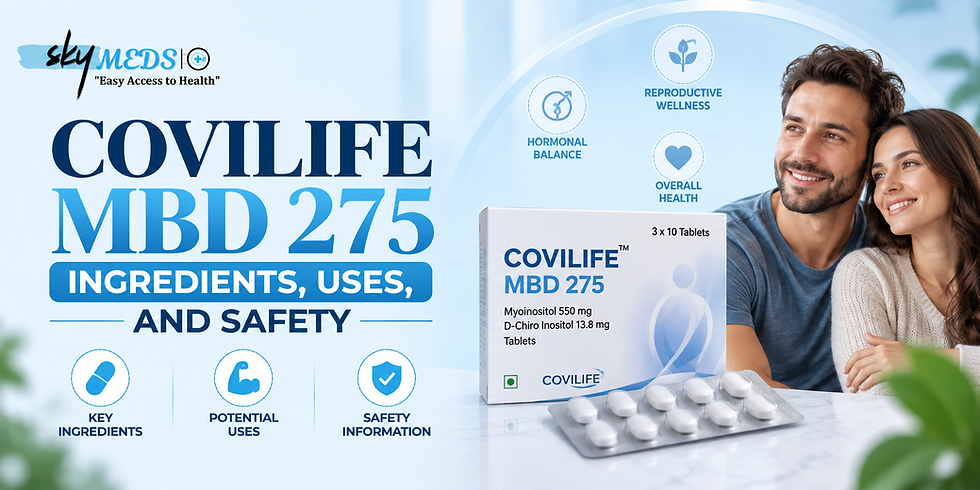
Covilife MBD 275 is a combination antiparasitic tablet containing ivermectin 25 mg and mebendazole 250 mg. Current product listings identify it as a Kachhela Medex product intended for the management of susceptible parasitic infections. The two medicines attack parasites differently: ivermectin interferes with parasite nerve and muscle function, while mebendazole disrupts processes parasites need to survive. However, the right antiparasitic treatment depends on the parasite involved, and the fixed strengths in Covilife MBD 275 should not be treated as a universal deworming dose. Pregnancy, body weight, other medicines, liver health, and the suspected infection can all affect treatment decisions. This guide explains the ingredients in Covilife MBD 275, their evidence-based uses, how they work, possible side effects, and the precautions to discuss with a healthcare professional.
What Is Covilife MBD 275?
Covilife MBD 275 is an oral antiparasitic medicine combining two active ingredients: ivermectin 25 mg and mebendazole 250 mg. Product information currently available online identifies the tablet as containing these two medicines and categorizes it as an antiparasitic or anthelmintic product.
"Anthelmintic" simply means a medicine used against parasitic worms.
The "275" in the product name appears to represent the combined 275 mg of its two active ingredients. However, that number should not be interpreted as a recommended dose for every parasitic infection.
What is in Covilife MBD 275 and what does each ingredient do?
Ingredient | Amount per listed tablet | Drug type | Main action |
Ivermectin | 25 mg | Antiparasitic/anthelmintic | Disrupts nerve and muscle activity in susceptible parasites, leading to paralysis and death |
Mebendazole | 250 mg | Benzimidazole anthelmintic | Interferes with essential processes that allow susceptible worms to survive |
Combined active ingredients | 275 mg | Combination antiparasitic | Provides two antiparasitic medicines with different mechanisms |
One caution is important when researching this product online: some retailer pages contain conflicting or inaccurate descriptions of Covilife MBD 275. For that reason, the physical package and prescribing information supplied with the medicine should be checked before use rather than relying solely on online seller descriptions.
What Is Covilife MBD 275 Used For?
Covilife MBD 275 is marketed for parasitic infections, particularly worm infestations. However, whether this particular fixed-dose combination is appropriate depends on the parasite, diagnosis, patient characteristics, and local prescribing information.
This distinction matters because ivermectin and mebendazole individually have recognized roles against particular parasites, but they are not interchangeable and are not automatically used together for every infection.
What infections is ivermectin used to treat?
Ivermectin is an established antiparasitic medicine. Its appropriate dose varies substantially according to the infection and the person's body weight.
For example, the CDC clinical guidance for Strongyloides infection lists ivermectin as first-line treatment for acute and chronic strongyloidiasis, an intestinal infection caused by the Strongyloides stercoralis worm.
Ivermectin is also used against onchocerciasis, or river blindness. For that infection, it acts primarily against immature worms called microfilariae rather than killing the adult worms.
These examples illustrate why a fixed 25 mg ivermectin tablet should not be assumed to provide the correct amount for every infection or every person.
What infections is mebendazole used to treat?
Mebendazole is particularly useful against several intestinal worms.
The CDC guidance on soil-transmitted helminth infections includes mebendazole among treatment options for infections such as ascariasis, whipworm, and hookworm. The recommended regimens differ according to the parasite.
Mebendazole also has roles in certain less common parasitic infections. Again, treatment duration and dose can differ considerably.
Covilife MBD 275 contains two established antiparasitic medicines, but that does not make one tablet an appropriate treatment for every worm or parasite. Correct antiparasitic treatment depends on identifying or strongly suspecting the infection and selecting the appropriate medicine and dose.
How Do Ivermectin and Mebendazole Work?
The two ingredients target susceptible parasites in different ways. This is the pharmacological rationale for combining them, although a combination should only be used when clinically appropriate.
How ivermectin works
Ivermectin acts on particular channels in the nerve and muscle cells of susceptible parasites. The resulting disruption leads to paralysis and death of the parasite.
Its effects vary according to the organism. In onchocerciasis, for example, CDC explains that ivermectin kills the immature microfilariae responsible for much of the disease but does not kill the adult worms.
How mebendazole works
Mebendazole belongs to the benzimidazole group of antiparasitic medicines. It disrupts structures and metabolic processes that worms require to obtain energy and survive.
This eventually depletes the parasite's energy stores and causes its death.
Because the medicines have different mechanisms, combining them may broaden antiparasitic activity.
However, a plausible mechanism is not by itself evidence that every parasitic infection requires or benefits from this particular combination.
How Should Covilife MBD 275 Be Used?
Covilife MBD 275 should be used according to professional medical advice and the verified product instructions because antiparasitic dosing varies by infection and patient. It is not appropriate to assume that "one tablet" is a standard treatment simply because some commercial product pages describe it that way.
This is especially important with ivermectin because many established regimens are calculated according to body weight.
For example, CDC recommends ivermectin 200 micrograms per kilogram for 1–2 days for uncomplicated strongyloidiasis. For ascariasis, CDC lists 150–200 micrograms/kg as one possible ivermectin regimen, while mebendazole regimens differ again.
The 25 mg of ivermectin and 250 mg of mebendazole contained in Covilife MBD 275 therefore should not be converted into a self-treatment regimen without clinical guidance.
Why antiparasitic treatment cannot be based on the product name alone
Factor | Why It Matters | Practical Meaning |
Type of parasite | Different parasites respond to different medicines | A treatment for one worm may be unsuitable for another |
Body weight | Ivermectin is often prescribed by weight | A fixed 25 mg amount is not automatically appropriate for everyone |
Location of infection | Intestinal, skin and tissue parasites behave differently | Diagnosis influences medicine selection |
Pregnancy/breastfeeding | Safety considerations differ | Professional advice is particularly important |
Age/child's weight | Some antiparasitic medicines have pediatric restrictions | Adult tablets should not simply be scaled down |
Other illnesses/medicines | Safety and interactions may change | A medication review may be necessary |
What Are the Possible Side Effects of Covilife MBD 275?
Because Covilife MBD 275 contains ivermectin and mebendazole, its safety needs to account for adverse effects associated with both active ingredients. The exact experience can vary with the infection, dose, duration, and individual patient.
Possible effects associated with antiparasitic treatment can include:
nausea or vomiting
abdominal discomfort
diarrhea
headache
dizziness
Not every symptom after treatment is necessarily a direct drug effect. With some parasitic diseases, reactions can occur as parasites die and the immune system responds to them.
More serious reactions are uncommon but require attention. Seek medical help for symptoms suggesting a severe allergic reaction, such as facial or throat swelling, severe rash, or difficulty breathing.
Longer or higher-dose antiparasitic treatment can have additional risks. For example, CDC notes that prolonged mebendazole treatment has been associated with bone marrow suppression in certain treatment settings.
Who Should Be Especially Careful With Covilife MBD 275?
Pregnant or breastfeeding people, young children, people with significant medical conditions, and anyone taking other medicines should seek professional advice before using this combination. The safety considerations for ivermectin and mebendazole are not identical.
Pregnancy and breastfeeding
Pregnancy requires particular caution because evidence for antiparasitic medicines can depend on the drug, infection, pregnancy stage, and treatment setting.
CDC notes that human pregnancy data for ivermectin are limited and that the World Health Organization excludes pregnant women from mass-prevention campaigns involving ivermectin. When an infection itself poses a health risk, clinicians must weigh the potential benefits of treatment against potential fetal risks.
Mebendazole also requires a risk-benefit assessment during pregnancy. CDC notes limited pregnancy data while describing circumstances in which WHO permits its use during the second and third trimesters in mass-treatment programs in endemic areas.
These public-health recommendations should not be interpreted as instructions to self-treat during pregnancy.
Children and body weight
Extra caution is necessary in young children. For ivermectin, CDC states that safety in children weighing less than 15 kg has not been established.
Because Covilife MBD 275 contains a fixed 25 mg of ivermectin, it should not be given to a child simply by estimating or dividing an adult dose.
Certain parasitic infections require special precautions
Ivermectin can be particularly dangerous in people with heavy Loa loa infection. This parasite occurs mainly in parts of Central and West Africa, and severe neurological reactions can occur when certain people with high parasite levels receive ivermectin.
The CDC guidance on ivermectin treatment for onchocerciasis advises that people with Loa loa co-infection should not be treated for onchocerciasis without expert consultation because of the risk of severe encephalitic reactions.
Travel and residence history can therefore be medically relevant when antiparasitic treatment is being considered.
When Should You Speak With a Healthcare Professional?
Speak with a healthcare professional if you suspect a parasitic infection rather than repeatedly taking deworming medicines without knowing the cause. Some intestinal parasites can be identified through stool testing, while other infections require different tests depending on the suspected organism.
Medical advice is particularly important before taking Covilife MBD 275 if you:
are pregnant, could be pregnant, or are breastfeeding
are considering giving it to a child
have significant liver or other chronic disease
take regular prescription medicines
have recently lived in or travelled to an area where Loa loa occurs
have severe or persistent gastrointestinal symptoms
continue having symptoms after antiparasitic treatment
are immunosuppressed or are about to begin corticosteroids or other immunosuppressive treatment
Strongyloides deserves particular attention in people who are immunosuppressed. CDC reports that disseminated or hyperinfection disease can become extremely serious, especially in people receiving high-dose corticosteroids.
Conclusion
Covilife MBD 275 is listed as a combination of ivermectin 25 mg and mebendazole 250 mg, two medicines with established activity against certain parasites. However, the correct treatment depends on the organism involved, body weight, medical history, and other factors. A fixed-dose combination should therefore not be assumed to be a general-purpose deworming treatment.
If you think you have a parasitic infection, consider speaking with a doctor or pharmacist before using Covilife MBD 275, particularly for a child, during pregnancy or breastfeeding, or if you take other medicines. This information is educational and does not replace diagnosis or individualized prescribing advice.


Frequently Asked Questions
1. What are the ingredients in Covilife MBD 275?
Current product information lists Covilife MBD 275 as containing ivermectin 25 mg and mebendazole 250 mg per tablet. Both are antiparasitic medicines, but they work differently. Check the physical package and supplied product information before use because online listings can contain inconsistent information.
2. What is Covilife MBD 275 used for?
Covilife MBD 275 is marketed for treating susceptible parasitic infections, particularly worm infestations. Ivermectin and mebendazole individually have established uses against particular parasites. The appropriate medicine and regimen depend on which parasite is causing the infection.
3. Can I take Covilife MBD 275 for routine deworming?
Do not assume this fixed-dose combination is appropriate for routine deworming. Different worms require different medicines and regimens, while ivermectin dosing is often based on body weight. A healthcare professional can determine whether treatment is needed and which medicine is suitable.
4. Is Covilife MBD 275 safe for children?
It should not automatically be given to children. Covilife MBD 275 contains 25 mg of ivermectin, while ivermectin dosing for several infections is weight-based. CDC states that ivermectin safety in children weighing under 15 kg has not been established.
5. Can Covilife MBD 275 be taken during pregnancy?
Pregnancy requires medical assessment before using ivermectin or mebendazole. Available pregnancy evidence is limited, and recommendations vary with the medicine, infection, and stage of pregnancy. Do not self-treat with Covilife MBD 275 during pregnancy without professional guidance.
6. What should I do if symptoms continue after taking an antiparasitic medicine?
Persistent symptoms should be medically evaluated rather than automatically repeating the medicine. The original diagnosis may be incorrect, the parasite may require another regimen, or follow-up testing may be necessary. For some infections, CDC specifically recommends testing after treatment when symptoms persist.


Comments