
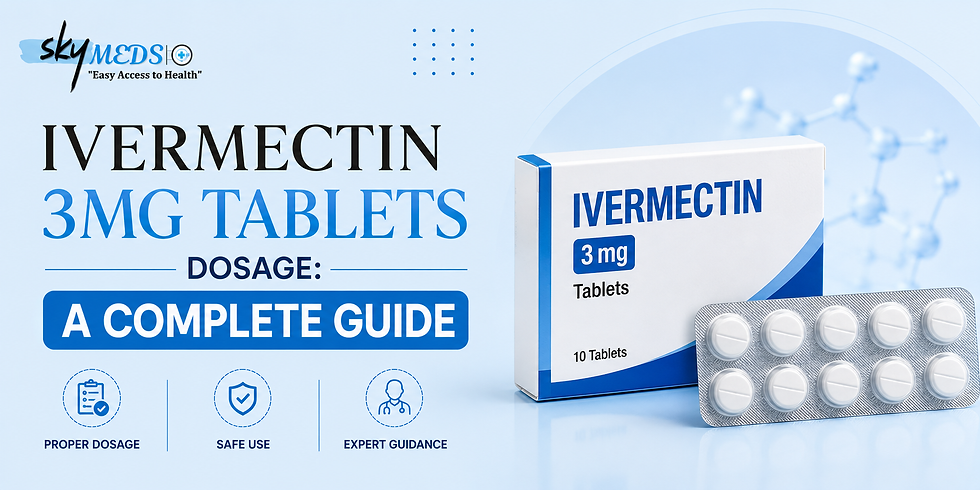
Ivermectin 3mg Tablets Dosage: A Complete Guide

Updated: Aug 25
Written by Dr. Zack Ferris in TheSkyMeds Editorial Standards
Medically reviewed by Jonathan Reed, Medical Content Reviewer Mar 27 2025
Ivermectin 3 mg tablets are a prescription oral formulation used for specific parasitic infections, but 3 mg is the strength of each tablet—not a standard dose for every adult. The total amount of ivermectin required depends mainly on the infection being treated and the patient's body weight.
Under current U.S. prescribing information:
Intestinal strongyloidiasis: approximately 200 mcg/kg as a single oral dose.
Onchocerciasis: approximately 150 mcg/kg as a single oral dose.
The official 3 mg tablet label provides different tablet-count tables for these two infections, which is why a generic statement such as “take X tablets” is not medically accurate without knowing the diagnosis and body weight.
Oral ivermectin is also used off-label for conditions such as scabies and, in selected cases, head lice, but these regimens follow different clinical guidance.
This guide explains what ivermectin 3 mg tablets are, how labeled doses vary by weight, FDA-approved uses, off-label uses, administration, repeat treatment, safety, interactions and special precautions.
For a broader adult weight reference, see Ivermectin Dosage Chart for Adults: US Medical Reference Guide.
Ivermectin 3mg Tablets : Quick Reference
Question | Evidence-Based Answer |
What does 3 mg mean? | Each tablet contains 3 mg of ivermectin |
Is 3 mg a standard adult dose? | No |
Is dosing based on weight? | Yes, for the major oral indications |
Strongyloidiasis dose | Approx. 200 mcg/kg |
Onchocerciasis dose | Approx. 150 mcg/kg |
FDA-approved oral uses | Strongyloidiasis and onchocerciasis |
Oral scabies use | Off-label |
Oral head-lice use | Off-label |
Safety established below 15 kg? | No |
Labeled administration | Empty stomach with water for FDA-labeled oral uses |
The current U.S. 3 mg ivermectin prescribing information provides these weight-based dosing tables and administration instructions.
What Are Ivermectin 3 mg Tablets?
Ivermectin belongs to the avermectin class of antiparasitic medicines.
A 3 mg ivermectin tablet contains 3 milligrams of active ivermectin, but the strength printed on the tablet should not be confused with the total treatment dose.
For example:
1 × 3 mg tablet = 3 mg
2 × 3 mg tablets = 6 mg
4 × 3 mg tablets = 12 mg
5 × 3 mg tablets = 15 mg
The required tablet count depends on the prescribed weight-based dose.
Current labeling explains that ivermectin acts on glutamate-gated chloride channels in susceptible invertebrate nerve and muscle cells, causing paralysis and death of susceptible parasites. It is active against some, but not all, parasite life stages.
For a simpler explanation of the mechanism, read How Ivermectin Works in the Body: Mechanism of Action Explained Simply.
What Are Oral Ivermectin Tablets FDA-Approved to Treat?
In the United States, oral ivermectin tablets are approved for two parasitic infections:
Intestinal Strongyloidiasis
Strongyloidiasis is caused by the roundworm Strongyloides stercoralis.
The current product label recommends approximately 200 mcg/kg as a single oral dose for intestinal, nondisseminated strongyloidiasis.
Onchocerciasis
Onchocerciasis, sometimes called river blindness, is caused by Onchocerca volvulus.
The labeled ivermectin dose is approximately 150 mcg/kg as a single oral dose.
Importantly, ivermectin kills Onchocerca microfilariae but does not kill the adult worms, which is why follow-up and retreatment may be required.
Ivermectin 3 mg Dosage for Strongyloidiasis
For intestinal strongyloidiasis, the current U.S. label recommends a single oral dose designed to provide approximately:
200 mcg of ivermectin per kg of body weight.
Strongyloidiasis Dosage Using 3 mg Tablets
Body Weight | Number of 3 mg Tablets |
15–24 kg | 1 tablet |
25–35 kg | 2 tablets |
36–50 kg | 3 tablets |
51–65 kg | 4 tablets |
66–79 kg | 5 tablets |
80 kg or more | Calculate approximately 200 mcg/kg |
These are label-based reference amounts, not personalized prescribing recommendations.
Important Point for People Weighing 80 kg or More
The label does not say every person weighing 80 kg or more should take exactly six 3 mg tablets.
Instead, for this weight group, the dose continues to be calculated at approximately:
200 mcg/kg.
So a fixed “80 kg+ = 18 mg” statement should not be used as a universal rule.
For a detailed kilogram-and-pound comparison, use Ivermectin Dosage Chart for Adults: US Medical Reference Guide.
Is One Dose Enough for Strongyloidiasis?
For uncomplicated intestinal strongyloidiasis, the U.S. product label generally describes a single oral dose followed by stool examinations to verify that the infection has cleared.
CDC clinical guidance is slightly different and lists:
200 mcg/kg orally for 1–2 days
as first-line therapy for acute and chronic strongyloidiasis. CDC recommends follow-up stool examinations 2–4 weeks after treatment in patients who had positive stool tests and continue to have symptoms. If larvae are detected again, retreatment is indicated.
This difference between the product label and CDC guidance is exactly why treatment should be condition-specific rather than copied from a generic online calculator.
Ivermectin 3 mg Dosage for Onchocerciasis
Onchocerciasis uses a different weight-based dose.
The current U.S. label recommends approximately:
150 mcg/kg as a single oral dose.
Onchocerciasis Dosage Using 3 mg Tablets
Body Weight | Number of 3 mg Tablets |
15–25 kg | 1 tablet |
26–44 kg | 2 tablets |
45–64 kg | 3 tablets |
65–84 kg | 4 tablets |
85 kg or more | Calculate approximately 150 mcg/kg |
Again, there is no single fixed tablet count for every patient above the highest weight band.
Why Can Onchocerciasis Require Repeat Treatment?
Ivermectin reduces the number of microfilariae but does not kill adult Onchocerca volvulus worms.
The current U.S. label notes that mass-distribution programs commonly use an interval of about 12 months, while individual retreatment can sometimes be considered at shorter intervals.
That does not mean people should schedule their own repeat doses.
Treatment frequency depends on the infection and clinical circumstances.
For more on parasite-clearance timing, see How Long Does It Take for Ivermectin to Kill Parasites? Timeline by Infection.
Are Ivermectin 3 mg Tablets Used for Scabies?
Yes, oral ivermectin is used for scabies in some patients, but oral ivermectin is not FDA-approved for scabies in the United States.
CDC lists oral ivermectin as an off-label option for classic scabies.
For classic scabies, CDC guidance describes:
200 mcg/kg per dose
Two oral doses
Each dose separated by 7–14 days
Taken with food
Why Does Scabies Treatment Differ From the Ivermectin Label?
The standard human ivermectin tablet label instructs patients treating strongyloidiasis or onchocerciasis to take the tablets on an empty stomach with water.
CDC scabies experts, however, recommend taking oral ivermectin with food for scabies to increase bioavailability.
This is a good example of why administration instructions cannot be generalized across every ivermectin use.
Why Is a Second Dose Used for Classic Scabies?
A second oral dose is commonly required because one treatment may not eliminate every stage of the infestation.
CDC recommends two doses 7–14 days apart for classic scabies when oral ivermectin is chosen.
This does not mean every ivermectin indication should automatically be repeated after 7–14 days.
What About Crusted Scabies?
Crusted scabies is a severe infestation and requires more intensive treatment.
CDC recommends combining oral ivermectin with a topical agent. Depending on severity, expert regimens can involve three, five or seven ivermectin doses on selected days. There is no single universally agreed optimal schedule.
Crusted scabies should therefore be medically managed rather than treated using a simple tablet-count chart.
Are Oral Ivermectin Tablets Used for Head Lice?
Oral ivermectin tablets are not FDA-approved for head lice, although CDC notes that oral ivermectin has been effective off-label in selected patients.
CDC describes oral doses of 200 mcg/kg or 400 mcg/kg, repeated after 9–10 days. CDC also advises against this oral approach in children weighing under 15 kg and in pregnancy.
Topical ivermectin lotion is a different product and should not be confused with oral 3 mg ivermectin tablets.
Is 200 mcg/kg the Standard Ivermectin Dose for Every Parasite?
No.
This is one of the most important points in this guide.
Different conditions use different regimens:
Condition | Example Guidance |
Strongyloidiasis | Approx. 200 mcg/kg |
Onchocerciasis | Approx. 150 mcg/kg |
Classic scabies | 200 mcg/kg per dose, repeated 7–14 days later |
Severe/disseminated Strongyloides | 200 mcg/kg daily until tests remain negative for 2 weeks |
The last regimen applies to serious hyperinfection/disseminated disease and requires medical management.
Therefore, “200 mcg/kg treats most parasites” is too broad.
Does Age Determine the Ivermectin 3 mg Dose?
Not by itself.
For oral ivermectin, body weight is an important dosing factor.
Current U.S. labeling states that safety and effectiveness have not been established in pediatric patients weighing less than 15 kg.
CDC also identifies patients weighing under 15 kg as a group requiring special consideration for Strongyloides treatment.
So describing ivermectin simply as being for “adults and children over 5 years” is not sufficiently accurate.
Can Children Take Ivermectin 3 mg Tablets?
Ivermectin can be used in some pediatric patients when medically appropriate, but dosing is based on the diagnosis and body weight.
The current U.S. label states:
Safety and effectiveness have not been established in children weighing less than 15 kg.
Parents should never estimate a child's treatment by splitting an adult dose without professional guidance.
How Should Ivermectin 3 mg Tablets Be Taken?
For FDA-labeled treatment of intestinal strongyloidiasis and onchocerciasis, the current product label instructs patients to take ivermectin tablets:
On an empty stomach
With water
At the prescribed total dose
However, as discussed earlier, CDC recommends administration with food when oral ivermectin is used for classic scabies.
Always follow instructions for the specific condition.
Do You Need to Avoid Food for One Hour After Ivermectin?
The current U.S. label says to take the tablets on an empty stomach with water for the labeled oral indications.
It does not provide a universal rule that every patient must avoid eating for a specific number of hours after every ivermectin use.
Follow the directions on the prescription and product label.
Should You Avoid Alcohol While Taking Ivermectin?
The current U.S. ivermectin label does not contain a universal instruction saying everyone must avoid alcohol.
Therefore, “never drink alcohol while taking ivermectin” should not be presented as a blanket product-label rule.
Patients with liver disease, medication interactions, dizziness, or other medical concerns should ask a clinician or pharmacist for individualized advice.
When Is Another Dose of Ivermectin Needed?
There is no universal repeat-dose schedule.
Strongyloidiasis
The product label generally describes a single oral treatment, followed by stool testing to confirm eradication.
CDC lists 200 mcg/kg for 1–2 days for acute and chronic Strongyloides.
Onchocerciasis
Retreatment can be necessary because adult worms remain alive.
Classic Scabies
CDC recommends two oral doses separated by 7–14 days.
Hyperinfection or Disseminated Strongyloidiasis
CDC recommends 200 mcg/kg daily until stool and/or sputum examinations remain negative for two weeks.
This severe condition requires medical management.
What Is the Difference Between Ivermectin 3 mg, 6 mg and 12 mg Tablets?
The number represents the amount of ivermectin in each tablet.
3 mg tablet = 3 mg ivermectin
6 mg tablet = 6 mg ivermectin
12 mg tablet = 12 mg ivermectin
For example, mathematically:
4 × 3 mg = 12 mg
But patients should not substitute tablet strengths unless the product and prescription allow it.
Availability and regulatory status of different strengths can vary between countries and manufacturers.
Are 3 mg Tablets Safer Than 12 mg Tablets?
Not automatically.
The safety of treatment depends more on the total amount of ivermectin taken, body weight, indication, other medicines and patient-specific factors than on the strength of each individual tablet.
Four 3 mg tablets contain the same total amount of ivermectin as one 12 mg tablet.
A lower tablet strength is therefore not automatically a lower treatment dose.
How Does Ivermectin Work Against Parasites?
Ivermectin binds selectively to glutamate-gated chloride channels found in susceptible invertebrate nerve and muscle cells.
This increases chloride permeability, causing hyperpolarization, paralysis and death of susceptible parasites.
Its activity is not universal.
The current label notes that ivermectin acts against tissue microfilariae of Onchocerca volvulus but not adult worms, and its action against Strongyloides stercoralis is limited to intestinal stages.
How Long Does Ivermectin Stay in the Body?
After oral administration, ivermectin reaches peak plasma concentrations at approximately four hours.
Its plasma half-life in humans is approximately 18 hours, while ivermectin and/or its metabolites are eliminated mainly through the feces over a longer period.
This does not mean another dose should automatically be taken after one half-life.
Treatment timing depends on the infection.
For parasite-specific timelines, read How Long Does It Take for Ivermectin to Kill Parasites? Timeline by Infection.
Common Side Effects of Oral Ivermectin
In strongyloidiasis clinical studies, reported drug-related adverse effects included:
Dizziness
Nausea
Diarrhea
Vomiting
Fatigue
Abdominal pain
Itching
Rash
Hives
Patients with onchocerciasis can experience inflammatory reactions associated with dying microfilariae, including itching, swelling, fever and lymph-node symptoms.
For a full safety overview, read Ivermectin Side Effects: Myths, Facts and Real Risks
Serious Ivermectin Reactions
Postmarketing reports have included serious adverse reactions such as:
Severe hypotension
Seizures
Hepatitis
Elevated liver enzymes
Stevens-Johnson syndrome
Toxic epidermal necrolysis
Altered consciousness
Confusion
Disorientation
Rare severe neurotoxicity
Significant neurological symptoms, severe rash, difficulty breathing, seizures or altered consciousness require urgent medical evaluation.
Loa loa and Ivermectin: Why Travel History Matters
One particularly important ivermectin warning concerns heavy Loa loa infection.
The U.S. label warns that people heavily infected with Loa loa can rarely develop severe or even fatal encephalopathy following treatment with a microfilaricidal medicine.
People with significant exposure to endemic regions of West or Central Africa may require assessment for loiasis before ivermectin treatment.
This is one reason travel history matters when evaluating parasitic infections.
Ivermectin and Warfarin
The current U.S. label reports rare postmarketing cases of increased INR when ivermectin was given with warfarin.
This does not mean every person taking any “blood thinner” automatically cannot use ivermectin.
It means patients taking warfarin should inform their prescriber and may require appropriate monitoring.
What About Immunosuppressants?
A blanket statement that “ivermectin must never be taken with immunosuppressants” is not supported by the label.
The more important issue is that immunosuppression can make Strongyloides infection significantly more dangerous.
CDC recommends heightened attention in people who:
Are taking or about to start corticosteroids or other immunosuppressive treatment
Have certain blood cancers
Are transplant candidates or recipients
Have unexplained eosinophilia
Have relevant travel or exposure history
Ivermectin During Pregnancy
Current U.S. labeling states that there are no adequate and well-controlled studies in pregnant women and that safety during pregnancy has not been established.
CDC also lists pregnancy as an important consideration in Strongyloides treatment decisions.
Pregnant patients should therefore not self-select a dose using an online ivermectin chart.
Ivermectin While Breastfeeding
Ivermectin is excreted into human milk in low concentrations.
Current labeling recommends weighing the potential risk to the infant against the risk of delaying necessary treatment in the mother.
Breastfeeding patients should discuss treatment with an appropriate healthcare professional.
Can Ivermectin 3 mg Tablets Treat COVID-19?
Ivermectin is not FDA-authorized or FDA-approved for preventing or treating COVID-19.
The FDA states that currently available clinical-trial evidence does not demonstrate that ivermectin is effective against COVID-19 in humans.
The fact that ivermectin has approved antiparasitic uses does not establish antiviral effectiveness.
Never Substitute Veterinary Ivermectin for Human Tablets
Human ivermectin tablets should not be replaced with:
Horse paste
Cattle injection
Veterinary pour-on
Animal drench
Other livestock formulations
FDA specifically warns that veterinary ivermectin products are different formulations from medicines approved for humans and that people have required medical attention, including hospitalization, after self-medicating with animal ivermectin.
What Happens After Taking Ivermectin?
The post-dose experience depends on the condition being treated.
Some people notice little immediately, while others may experience:
Dizziness
Gastrointestinal symptoms
Itching
Fatigue
Inflammatory symptoms related to parasite death
Symptoms alone do not always confirm whether an infection has cleared.
How Should Ivermectin 3 mg Tablets Be Stored?
The current Viona Pharmaceuticals 3 mg label specifies storage at:
20°C to 25°C (68°F to 77°F)
with permitted excursions between:
15°C and 30°C (59°F to 86°F).
Storage instructions can vary slightly between manufacturers, so always follow the exact package labeling.
For more information, read How to Store Ivermectin Tablets Properly: Complete Safety & Shelf-Life Guide.
Conclusion
Ivermectin 3 mg tablets should not be interpreted as a standard 3 mg adult treatment dose.
The 3 mg number simply describes the amount of ivermectin contained in each tablet.
For intestinal strongyloidiasis, current U.S. labeling uses approximately 200 mcg/kg. For onchocerciasis, it uses approximately 150 mcg/kg. The corresponding number of 3 mg tablets therefore changes according to body weight.
Other conditions follow different rules. Oral scabies and head-lice treatment are off-label, and CDC guidance uses different repeat-dose and administration schedules.
The safest way to interpret an ivermectin dosage chart is to start with the diagnosed infection, then consider body weight, the exact human formulation and condition-specific guidance.
For the full adult weight reference, continue to Ivermectin Dosage Chart for Adults: US Medical Reference Guide.
For more educational content, visit Theskymeds Ivermectin Guides.
Frequently Asked Questions
1. Is 3 mg ivermectin a normal adult dose?
3 mg is a tablet strength, not a universal adult dose. The total dose depends on body weight and the condition being treated.
2. How many 3 mg ivermectin tablets should an adult take?
There is no single tablet count for all adults. Strongyloidiasis and onchocerciasis have different weight tables in current U.S. labeling.
3. How many 3 mg tablets are used for strongyloidiasis?
The U.S. table ranges from one tablet for 15–24 kg to five tablets for 66–79 kg. At 80 kg or above, the dose is calculated at approximately 200 mcg/kg rather than using one fixed tablet count.
4. How many 3 mg tablets are used for onchocerciasis?
Current labeling uses one tablet at 15–25 kg, two at 26–44 kg, three at 45–64 kg and four at 65–84 kg. At 85 kg or more, approximately 150 mcg/kg is calculated.
5. Can children take ivermectin 3 mg?
Safety and effectiveness have not been established in children weighing less than 15 kg.
6. Is ivermectin dosage based on age or body weight?
Body weight is central to the dosing tables for the major oral indications.
7. Should ivermectin 3 mg be taken with food?
For FDA-labeled oral strongyloidiasis and onchocerciasis treatment, the label says to take ivermectin on an empty stomach with water. CDC recommends taking it with food when used off-label for classic scabies.
8. Is 18 mg the maximum ivermectin dose for adults?
No universal 18 mg maximum is established by the weight tables discussed here. Above specified weight bands, the labeled dose continues to be calculated in mcg/kg.
9. Can ivermectin be repeated after 7–14 days?
Only when the specific treatment regimen calls for it. CDC uses a repeat dose 7–14 days later for classic scabies, while strongyloidiasis and onchocerciasis use different schedules.
10. Are ivermectin 3 mg tablets FDA-approved for scabies?
No. Oral ivermectin is used off-label for scabies in the United States.
11. Can ivermectin treat head lice?
Oral ivermectin tablets are not FDA-approved for head lice, although CDC describes off-label oral use in selected patients.
12. Can ivermectin treat COVID-19?
No FDA-approved or authorized ivermectin indication exists for COVID-19, and FDA says currently available clinical trial data do not demonstrate effectiveness.


Comments