
Jackfruit Seeds for Men: Nutrition and Health Benefits

Written by Dr. Zack Ferris in TheSkyMeds Editorial Standards
Medically reviewed by Jonathan Reed, Medical Content Reviewer Sept 12 2026
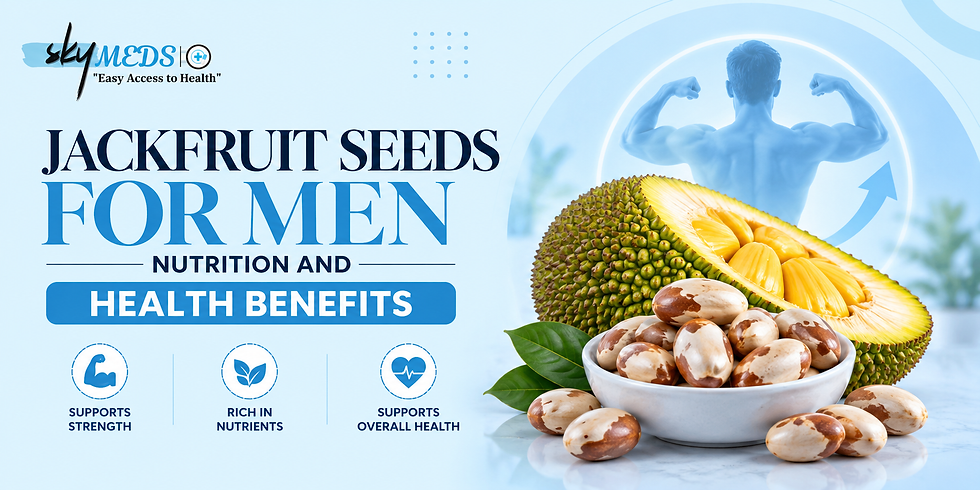
Jackfruit seeds are often discarded, but when properly cooked they can add starch, plant protein, fibre, resistant starch, and small amounts of minerals and bioactive compounds to the diet. Interest in jackfruit seeds for men often centres on energy, digestion, muscle nutrition, heart health, blood sugar, testosterone, and fertility. Research supports their value as a nutritious food, but there is currently little human evidence showing that jackfruit seeds provide health effects unique to men. A 2023 analysis found meaningful amounts of protein, dietary fibre, and resistant starch in boiled and roasted seeds, while a 2025 review also highlighted their starch, protein, and phenolic compounds. Claims that jackfruit seeds directly increase testosterone, sperm count, sexual performance, or fertility go beyond the available evidence. This guide separates realistic nutritional benefits from popular claims and explains how men can include cooked jackfruit seeds safely in a balanced diet.
What Nutrition Do Jackfruit Seeds Provide?
Jackfruit seeds are primarily a carbohydrate-rich food rather than a high-protein nut or seed such as almonds, peanuts, or pumpkin seeds. Their exact nutrient content varies with variety, maturity, processing, moisture content, and whether values are reported for fresh seeds, dried flour, or cooked seeds.
A 2023 study examining raw, boiled, and roasted jackfruit seeds found approximately 9.9–10.2 g of protein and 12.11–13.83 g of dietary fibre per 100 g in the analysed samples, along with substantial resistant starch.
Other datasets report different values because preparation and moisture content differ considerably.
The research on nutritional properties and safe consumption of jackfruit seeds is therefore useful for understanding their overall nutritional profile without treating a single nutrient number as universal.
Why does resistant starch matter?
Resistant starch is starch that escapes digestion in the small intestine and reaches the large bowel, where some of it can be fermented by gut bacteria. In this respect, it behaves differently from rapidly digested starch.
A small human nutrition study found that cooked jackfruit seeds contained dietary fibre and resistant starch, although the researchers tested a complete jackfruit meal rather than isolated jackfruit seeds alone. This distinction matters when translating experimental results into everyday dietary advice.
What jackfruit seeds contribute nutritionally and what that may mean for men's health
Nutritional feature | What jackfruit seeds can provide | Practical relevance |
Carbohydrate and starch | Major part of the seed's energy content | Provides dietary energy but still contributes carbohydrate to a meal |
Plant protein | Moderate amounts rather than exceptionally high protein | Can contribute to total daily protein but should not replace richer protein sources when needs are high |
Dietary fibre | Meaningful amounts in several analyses | Supports bowel regularity and overall dietary fibre intake |
Resistant starch | Present in cooked and processed seeds | May support colonic fermentation and influence post-meal carbohydrate digestion |
Phenolic compounds | Compounds such as catechin, ferulic acid, rutin and gallic acid have been reported | Show antioxidant activity in laboratory studies, but this does not prove disease prevention in humans |
Minerals | Composition varies between studies and preparation methods | Can make a modest contribution within a varied diet rather than acting as a concentrated mineral supplement |
What Are the Main Health Benefits of Jackfruit Seeds for Men?
For men, the most defensible benefits are the same fundamental nutritional benefits that apply to other adults: adding dietary variety, fibre, resistant starch, carbohydrate energy, and some plant protein. There is not enough clinical research to label jackfruit seeds a male-specific functional food.
They can contribute to daily protein intake
Protein provides amino acids used for muscle, enzymes, hormones, immune proteins, and other tissues.
Jackfruit seeds contain protein, although they are not as protein-dense as many legumes, dairy foods, eggs, fish, meat, soy foods, or some nuts and seeds.
The WHO notes that proteins provide structural and functional building blocks in the body and that adults can obtain protein from a mixture of plant and animal sources. WHO healthy-diet guidance on protein and balanced nutrition emphasizes the overall dietary pattern rather than relying on one food to meet nutritional needs.
For a man trying to maintain or build muscle, jackfruit seeds can therefore be part of a meal, but they should not be described as a muscle-building substitute for an adequately protein-rich diet.
They may support digestive health
Jackfruit seeds can provide dietary fibre and resistant starch. Both can affect stool bulk and gastrointestinal fermentation, while resistant starch can serve as a substrate for intestinal microorganisms.
That does not mean larger portions are always better. Rapidly increasing fibre or resistant-starch intake may produce gas, bloating, or abdominal discomfort in some people.
They provide useful carbohydrate energy
Because starch makes up a substantial part of jackfruit seeds, they can function more like a starchy food than a conventional high-fat seed. Boiled or roasted seeds can therefore contribute energy to meals and snacks.
For physically active men, carbohydrate is an important energy source, particularly when activity is prolonged or intense. Jackfruit seeds are simply one possible food source rather than a proven performance enhancer.
They contain compounds with antioxidant activity
Laboratory analyses have identified phenolic compounds and antioxidant activity in jackfruit seed flour.
One study reported polyphenols as well as antioxidant activity in chemical assays.
The word “antioxidant,” however, can easily be overstated. Demonstrating antioxidant activity in a laboratory does not prove that eating jackfruit seeds prevents cardiovascular disease, cancer, infertility, or other diseases in humans.
Jackfruit seeds can be a nutritious starchy plant food, but their value for men comes primarily from nutrients such as fibre, resistant starch and some protein. There is currently no good clinical evidence that they act as a natural testosterone booster, fertility treatment, aphrodisiac, or male-performance supplement.
Do Jackfruit Seeds Increase Testosterone, Fertility, or Sexual Health?
There is currently no convincing human clinical evidence that eating jackfruit seeds increases testosterone, improves erectile function, raises sperm count, or treats male infertility. Claims linking them directly to male sexual or reproductive performance should therefore be viewed cautiously.
This is an important distinction because jackfruit seeds do contain nutrients and plant compounds involved broadly in human health. Having nutrients that participate in normal physiology is not the same as demonstrating that a particular food raises testosterone or reverses infertility.
What about antioxidants and sperm health?
Oxidative stress is one area studied in male infertility, and antioxidant supplements have been investigated for possible effects on semen quality. Results across studies are mixed.
For example, the large multicentre MOXI randomized trial found that a combined antioxidant supplement did not produce the hoped-for improvement in semen quality or live-birth outcomes among men with male-factor infertility. Other antioxidant trials have reported improvements in selected semen measurements, which illustrates why evidence cannot be transferred automatically from an antioxidant supplement—or another plant—to jackfruit seeds.
No comparable clinical trial establishes jackfruit seeds as a fertility treatment.
Can they boost testosterone because they contain protein or minerals?
No such conclusion can currently be made. Adequate nutrition is important for normal hormone production, but eating one nutrient-containing food does not necessarily push testosterone above an individual's normal physiological level.
Low testosterone can have several causes, including testicular disorders, pituitary or hypothalamic conditions, obesity, some medicines, chronic disease, sleep disorders, and ageing-related changes. Men concerned about persistent symptoms should seek appropriate medical evaluation rather than relying on a food marketed as a hormone booster.
Could Jackfruit Seeds Help With Blood Sugar, Heart Health, or Weight?
Jackfruit seeds have nutritional characteristics that may fit into a balanced metabolic-health diet, but direct clinical evidence for treating diabetes, high cholesterol, obesity, or cardiovascular disease with the seeds themselves is limited.
Blood sugar and resistant starch
Resistant starch and fibre can influence carbohydrate digestion, so jackfruit seeds have attracted interest in glucose control. A small study involving 10 healthy adults found that a jackfruit meal containing boiled flesh and seeds had features associated with slower carbohydrate availability, but it did not test jackfruit seeds alone as a diabetes treatment.
Another randomized study in 40 adults with type 2 diabetes reported improved glucose measures when green jackfruit flour replaced an equivalent volume of rice or wheat flour for 12 weeks. However, that product was made from green jackfruit flour rather than isolated jackfruit seeds, so the finding should not be presented as proof that eating jackfruit seeds lowers blood sugar.
Heart health
Fibre-rich plant foods are generally useful components of a heart-healthy diet. Jackfruit seeds can contribute to that dietary pattern, particularly when boiled or roasted instead of being prepared with large amounts of salt, sugar, or saturated fat.
However, there are not strong human trials showing that jackfruit seeds specifically lower cholesterol, blood pressure, heart-attack risk, or cardiovascular mortality.
Weight management
Jackfruit seeds can be filling because they provide starch, fibre, and some protein. That may make them a satisfying substitute for more energy-dense fried snacks in some diets.
They are not, however, a proven weight-loss food. Body-weight change ultimately depends on the broader diet, energy intake, physical activity, sleep, health conditions, medications, and other individual factors.
Popular claims about jackfruit seeds for men compared with the current evidence
Common claim | What the evidence currently supports |
“They boost testosterone” | Not demonstrated in human clinical trials |
“They improve sperm count” | No good direct human evidence for jackfruit seeds |
“They increase male fertility” | Not established; infertility requires diagnosis rather than food-based treatment |
“They build muscle” | They contribute some protein and energy, but are not a high-protein muscle-building supplement |
“They improve digestion” | Fibre and resistant starch provide a reasonable nutritional basis for digestive benefits |
“They control diabetes” | Seed-specific treatment evidence is insufficient; do not replace diabetes treatment with jackfruit seeds |
“They protect the heart” | They can fit into a fibre-rich plant-based diet, but disease-specific protection has not been proven |
“They provide antioxidants” | Antioxidant compounds and activity have been demonstrated mainly in laboratory analyses |
How Should Men Eat Jackfruit Seeds Safely?
Jackfruit seeds are generally eaten after cooking rather than treated like a raw snack seed. Boiling and roasting are common preparation methods and also alter their texture, digestibility, starch structure, and antinutritional compounds.
The 2025 scientific review of jackfruit seed nutrition and food applications describes jackfruit seeds as rich in starch and containing protein and bioactive compounds while also discussing antinutritional factors that need to be considered during food preparation.
Boiling jackfruit seeds
Seeds can be washed and boiled until the interior becomes tender. Depending on the preparation, the outer covering can then be peeled before the cooked seed is added to curries, vegetable dishes, mashed preparations, or snacks.
Boiling is a straightforward option because it cooks the seed thoroughly without requiring added fat.
Roasting jackfruit seeds
Cooked or appropriately prepared seeds can also be roasted to create a firmer snack. Roasting changes moisture, flavour, and starch properties.
The nutritional composition of roasted seeds cannot be assumed to be identical to raw or boiled seeds because heat treatment and water loss alter measured nutrient concentrations.
What about jackfruit seed flour?
Dried, processed jackfruit seed flour can be incorporated into breads and other foods. A 2026 food-science study found that adding jackfruit seed flour to bread increased protein and fibre modestly as the proportion of seed flour increased.
That makes the flour potentially useful as a food ingredient, but a food-product study does not establish medicinal benefits.
Are There Any Side Effects or People Who Should Be Careful?
For most healthy adults, properly prepared jackfruit seeds can be treated as food rather than medicine. Still, portion size, digestive tolerance, preparation, allergies, and existing health conditions can matter.
Large portions may cause bloating, gas, or digestive discomfort, particularly when someone is not accustomed to fibre-rich or resistant-starch foods.
Jackfruit seeds also contain naturally occurring antinutritional compounds, including reported tannins, phytates, and trypsin inhibitors. These substances can influence digestion or mineral availability, and processing techniques such as boiling and roasting can alter their levels.
People with a known jackfruit allergy should avoid the seeds. Anyone who develops hives, facial or throat swelling, wheezing, breathing difficulty, dizziness, or another potentially serious allergic reaction after eating jackfruit should seek urgent medical care.
Men with diabetes should also remember that jackfruit seeds contain substantial carbohydrate. If glucose levels are being closely managed with medication or insulin, the seeds should be counted as part of the overall meal rather than considered a free “diabetic food.”
Conclusion
Jackfruit seeds for men can be a nutritious addition to a varied diet because they provide carbohydrate, fibre, resistant starch, some plant protein, and naturally occurring bioactive compounds. These features may support normal nutrition, digestive health, and dietary variety, especially when the seeds replace highly processed snacks.
Their benefits should not be exaggerated. Human research does not currently show that jackfruit seeds raise testosterone, improve erections, increase sperm count, or treat male infertility. Eat them properly cooked and in sensible portions as food, not as medicine. Men with persistent fertility, sexual-health, metabolic, or hormonal concerns should seek appropriate clinical assessment rather than relying on a single food.


Frequently Asked Questions
1. Are jackfruit seeds good for men?
Yes, properly cooked jackfruit seeds can be a nutritious food for men. They provide starch, dietary fibre, resistant starch and some plant protein. Their benefits are mainly nutritional, however, and research has not established unique male-specific effects such as higher testosterone or improved fertility.
2. Do jackfruit seeds increase testosterone?
There is no good human clinical evidence showing that jackfruit seeds raise testosterone. They contain useful nutrients, but that does not make them a testosterone booster. Men with persistent symptoms of low testosterone should discuss appropriate testing and possible causes with a healthcare professional.
3. Can jackfruit seeds improve sperm count or male fertility?
No direct clinical evidence shows that jackfruit seeds improve sperm count, sperm quality, or pregnancy outcomes. Nutrition is important for reproductive health, but male infertility has many possible causes. Persistent fertility problems warrant medical evaluation rather than treatment with a particular food.
4. Are jackfruit seeds high in protein?
Jackfruit seeds contain useful amounts of plant protein, but they are primarily a starch-rich food rather than a concentrated protein source. Men with higher protein needs should obtain protein from a varied diet that may include legumes, soy, dairy, eggs, fish, meat, nuts, or seeds.
5. Can people with diabetes eat jackfruit seeds?
They may fit into some diabetes meal plans, but jackfruit seeds still contain substantial carbohydrate. Fibre and resistant starch may influence digestion, yet the seeds are not a diabetes treatment. Portion size and the rest of the meal remain important, particularly for people using glucose-lowering medicines.
6. Can jackfruit seeds be eaten raw?
Cooking is the more appropriate approach. Jackfruit seeds are commonly boiled or roasted, and heat treatment improves palatability while altering naturally occurring antinutritional compounds. Wash and cook them thoroughly rather than treating raw jackfruit seeds like ready-to-eat nuts or conventional snack seeds.


Comments