
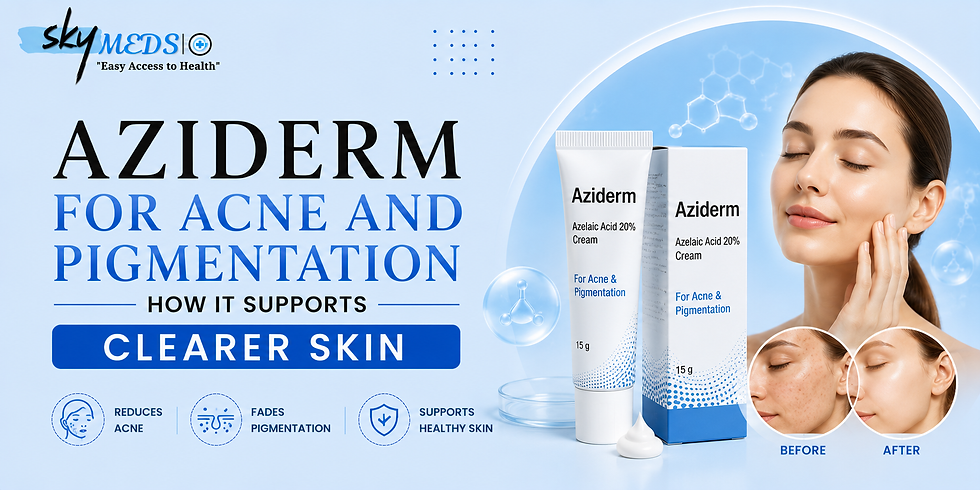
Aziderm for Acne and Pigmentation: How It Supports Clearer Skin

Updated: Aug 3
Updated: 30/07/2026| 6 min read
Written by Elizabeth Chernoby in Theskymeds Team
Editorially reviewed by Jonathan Reed, Medical Content Reviewer on 30/07/2026
Introduction
A pimple may disappear in a few days, but the dark mark it leaves behind can stay visible for weeks or even months. This is one reason acne treatment can feel frustrating: the breakout improves, yet the skin still does not look clear.
Aziderm is often discussed because it contains azelaic acid, an ingredient that can support two related skin concerns at the same time: acne and the uneven pigmentation that may appear after inflammation.
Dermatology guidance recognizes topical azelaic acid as an option that can help unclog pores, address acne-related bacteria and inflammation, and fade dark spots left after acne.
That combination makes it especially interesting for people who are not only trying to reduce new breakouts but also improve the appearance of old acne marks.
However, clearer skin usually does not come from using more product or expecting overnight results. The better approach is understanding what azelaic acid does, introducing it gradually, protecting the skin from the sun, and giving the routine enough time to work.
Key Takeaways
Aziderm contains azelaic acid, an ingredient used for acne and certain pigmentation concerns.
It may help reduce acne-related inflammation and support clearer-looking pores.
It can also help improve the appearance of post-inflammatory hyperpigmentation, or dark marks left after acne.
Results usually require consistent use rather than occasional application.
Mild tingling, burning, dryness, or irritation can occur, particularly when starting.
Sunscreen is important because ongoing UV exposure can make pigmentation more noticeable.
Severe, painful, widespread, or persistent acne may require a dermatologist-led treatment plan.
What Is Aziderm?
Aziderm is a topical product containing azelaic acid. Depending on the specific formulation, it may be available in different strengths and forms. The exact product instructions should always be checked before use.
Azelaic acid is a naturally occurring dicarboxylic acid that has been studied for acne and hyperpigmentation. Research has linked its effects to several actions, including antibacterial, anti-inflammatory, and skin-cell-normalizing properties.
In simple terms, azelaic acid can support skin in several ways:
It may help reduce acne-causing microbial activity.
It can help calm inflammation associated with breakouts.
It may support more normal shedding of skin cells.
It can help reduce the appearance of certain dark spots by influencing excess pigment production.
This multi-purpose action is why azelaic acid is often considered useful for people who have both active acne and lingering pigmentation.
How Aziderm Supports Acne-Prone Skin
Acne is not caused by just one factor. Pores can become clogged, oil production can increase, inflammation can develop, and acne-associated bacteria can contribute to the process.
Azelaic acid can work across some of these factors. The American Academy of Dermatology lists topical azelaic acid among acne treatment options because it can help unclog pores, address bacteria, and fade dark spots that remain after acne clears.
It May Help With Inflammation
Inflammation is one of the reasons acne can become red, swollen, and uncomfortable. By supporting a calmer skin environment, azelaic acid may help improve the appearance of inflammatory breakouts over time.
This is particularly relevant for people whose acne frequently leaves behind visible red or brown marks.
It Can Support Pore Clarity
When dead skin cells accumulate inside pores, they can contribute to congestion. Azelaic acid has keratinization-normalizing properties, meaning it may help support a more balanced process of skin-cell turnover.
This does not mean it acts like an instant pore-cleaning treatment. Instead, its benefits are generally seen through consistent use over time.
It May Help Reduce Acne-Related Bacteria
Azelaic acid has antibacterial properties that can contribute to its role in acne management. This is one reason it has been studied as a topical treatment for mild to moderate acne.
For many people, the goal is not simply to treat one existing pimple. It is to create a routine that helps reduce the cycle of repeated breakouts.
How Aziderm May Help With Pigmentation
Many people use the term “acne scars” to describe every mark left after a breakout. But not all marks are the same.
A flat brown or dark mark is often related to post-inflammatory hyperpigmentation. A red or pink mark may be post-inflammatory erythema. A depressed or raised texture change is a true acne scar and usually requires a different treatment approach.
Azelaic acid is particularly relevant to pigmentation because it can help reduce excess melanin production in the skin. Clinical research has found that 20% azelaic acid improved facial hyperpigmentation more than a vehicle treatment in darker skin types over a 24-week treatment period.
This is important because pigmentation can be especially persistent in medium to deep skin tones.
It Can Target Post-Acne Dark Marks
When acne causes inflammation, the skin may produce more pigment during the healing process. The result can be a brown or dark spot that remains after the original breakout has disappeared.
Azelaic acid may help improve the appearance of these marks gradually.
This does not mean every mark will disappear completely, and results depend on factors such as:
The depth and type of pigmentation
Skin tone
The severity of the original acne
Continued sun exposure
The consistency of treatment
Whether new acne continues to create new marks
The most effective approach is often to treat both the acne and the pigmentation at the same time.
Aziderm for Acne and Pigmentation: Why This Combination Matters
A common skincare mistake is treating acne first and waiting until the skin is completely clear before thinking about pigmentation.
In reality, these concerns are often connected.
A new breakout can create inflammation. Inflammation can leave behind a dark mark. The person then tries several strong products to fade the mark. Irritation may follow, potentially making the skin look more uneven.
Azelaic acid can be useful because it may support both acne management and the appearance of post-acne pigmentation.
Clearer skin is usually built through consistent, well-tolerated care—not by constantly switching from one aggressive treatment to another.
This does not make azelaic acid a universal solution. Acne can have different causes and levels of severity. But for suitable users, its ability to address multiple concerns makes it a practical ingredient to discuss with a skincare professional.
How to Introduce Aziderm Into a Skincare Routine
A common reason people stop using active skincare products is starting too aggressively.
Even ingredients considered relatively well tolerated can cause irritation when used too frequently or combined with too many other actives.
A simple approach is:
Step 1: Start Slowly
If you are new to azelaic acid, begin according to the product directions and your skin's tolerance. Some people may need to use it less frequently at first before gradually increasing use.
Do not assume that applying more will produce faster results.
Step 2: Apply to Clean, Dry Skin
After cleansing, allow the skin to dry before applying the product if your skin is prone to stinging or irritation.
Use the amount recommended on the product label or by a healthcare professional.
Step 3: Follow With Moisturizer
A gentle moisturizer can help support the skin barrier, especially if dryness or irritation develops.
A basic routine may look like this:
Morning
Gentle cleanser
Moisturizer
Broad-spectrum sunscreen
Evening
Gentle cleanser
Aziderm or another prescribed skincare treatment
Moisturizer
The ideal routine may differ depending on other products or medications being used.
Why Sunscreen Matters When Treating Pigmentation
Treating pigmentation without protecting the skin from UV exposure is like trying to fill a bucket while water is still leaking out.
Sun exposure can make existing pigmentation appear darker and may contribute to the persistence of uneven skin tone. This is why sunscreen is an important part of a routine focused on dark spots.
For daytime skincare, use a broad-spectrum sunscreen and reapply as appropriate for your activities and exposure.
This is especially important when using products that may cause irritation. Irritated skin can be more vulnerable to developing or worsening discoloration.
What Results Can You Expect?
Skincare results are rarely instant.
For acne, the American Academy of Dermatology notes that people may begin seeing fewer breakouts after several weeks, while more substantial clearing can take longer.
Pigmentation can take even longer because the skin needs time to gradually reduce the appearance of excess pigment.
A realistic timeline may look like this:
Concern | What to Expect |
Mild irritation | May occur early and often improves as skin adjusts |
Active acne | Improvement generally requires consistent use over several weeks |
Post-acne pigmentation | Often takes longer to fade and may require months of consistent care |
Severe acne or deep scarring | May need additional professional treatment |
The exact timeline varies from person to person.
A useful habit is to assess progress over several weeks rather than judging the product after only a few applications.
Possible Side Effects and Skin Irritation
Azelaic acid is often well tolerated, but irritation is still possible.
Some people may experience:
Mild tingling
Burning or stinging
Itching
Dryness
Redness
Flaking
Clinical research on 20% azelaic acid for hyperpigmentation found slightly higher levels of burning and stinging compared with vehicle treatment during parts of the study period.
If irritation is severe, persistent, or worsening, stop and seek professional advice.
Do not continue using a product simply because you believe intense burning means it is working better.
Common Mistakes to Avoid
Using Too Much
More product does not necessarily mean better results. Excessive application may increase irritation.
Starting Multiple Strong Actives at Once
Introducing azelaic acid at the same time as several exfoliating acids, retinoids, or other potentially irritating treatments can make it difficult to identify what is causing a reaction.
Skipping Moisturizer
People with acne-prone skin sometimes avoid moisturizer because they worry it will make their skin oily. However, a suitable non-comedogenic moisturizer can help support the skin barrier.
Picking Acne
Picking or squeezing breakouts can increase inflammation and raise the risk of lingering marks.
Expecting It to Remove Every Type of Scar
Azelaic acid may help with some forms of post-acne pigmentation. It is not designed to erase deep indentations or raised acne scars.
Who May Benefit From Azelaic Acid?
Azelaic acid may be worth discussing with a dermatologist or healthcare professional if you have:
Mild to moderate acne
Post-acne dark marks
Uneven skin tone
Acne-prone skin with pigmentation concerns
Skin that does not tolerate some stronger acne treatments well
However, suitability depends on your individual skin condition and the other products or medications you use.
When Should You See a Dermatologist?
Consider professional advice if:
Acne is painful, deep, or widespread.
Breakouts are leaving significant scars.
Pigmentation continues to worsen.
You have persistent irritation.
Your acne is affecting your confidence or daily life.
You have tried a consistent routine without improvement.
The American Academy of Dermatology specifically notes that persistent acne and post-acne dark spots may require a dermatologist-guided treatment plan.
Aziderm vs. Other Acne and Pigmentation Ingredients
No single ingredient is best for everyone.
Some acne treatments focus primarily on unclogging pores. Others target bacteria, inflammation, oil production, or pigment.
Azelaic acid is attractive because it may address more than one concern at once. That can make it useful for someone who has both breakouts and dark marks.
However, the best treatment depends on:
The type of acne present.
The severity of the acne.
The type of pigmentation.
Skin sensitivity.
Previous treatment history.
Other medications or skincare products being used.
A dermatologist can help determine whether azelaic acid should be used alone or as part of a broader treatment plan.
Conclusion
Aziderm can be a useful option for people dealing with the frustrating combination of acne and post-acne pigmentation. Its active ingredient, azelaic acid, has properties that can support acne management while also helping improve the appearance of certain dark spots over time.
The key is to keep expectations realistic. Clearer-looking skin usually comes from consistent treatment, gentle skincare, sun protection, and patience. Starting slowly may also help reduce unnecessary irritation.
If acne is severe, persistent, painful, or leaving significant scars, professional guidance is important. The right routine should address not only the spots already visible on the skin but also the factors contributing to new breakouts.
When used appropriately, azelaic acid can be a valuable part of a balanced skincare strategy—especially for people who want to work on both acne and uneven pigmentation without constantly changing products.

FAQ Section
FAQ 1: Is Aziderm good for acne?
Aziderm contains azelaic acid, which may help support the management of mild to moderate acne by addressing factors such as inflammation, acne-associated bacteria, and clogged pores. The most suitable treatment depends on the type and severity of acne.
FAQ 2: Can Aziderm help with acne marks?
It may help improve the appearance of post-acne dark marks, also known as post-inflammatory hyperpigmentation. Results are gradual and can vary depending on the depth and type of pigmentation.
FAQ 3: How long does Aziderm take to show results?
Some people may notice acne improvement after several weeks, but pigmentation often takes longer. Consistent use and daily sun protection are important for evaluating progress over time.
FAQ 4: Can Aziderm cause irritation?
Yes. Some users may experience stinging, burning, dryness, itching, redness, or flaking. Starting carefully and following product directions can help reduce the risk of irritation.
FAQ 5: Should sunscreen be used with Aziderm?
Yes. Sunscreen is especially important when your goal is to improve pigmentation because UV exposure can make dark spots more noticeable and harder to fade.
FAQ 6: Can Aziderm remove acne scars?
Aziderm may help with some flat, dark marks left after acne, but true depressed or raised acne scars are different. These often require other professional treatment options.


Comments